AI companion statistics.
What the research says.
How many people use AI for friendship, romance and support, why they use it, and how big the app market has become. Every number links to its source.
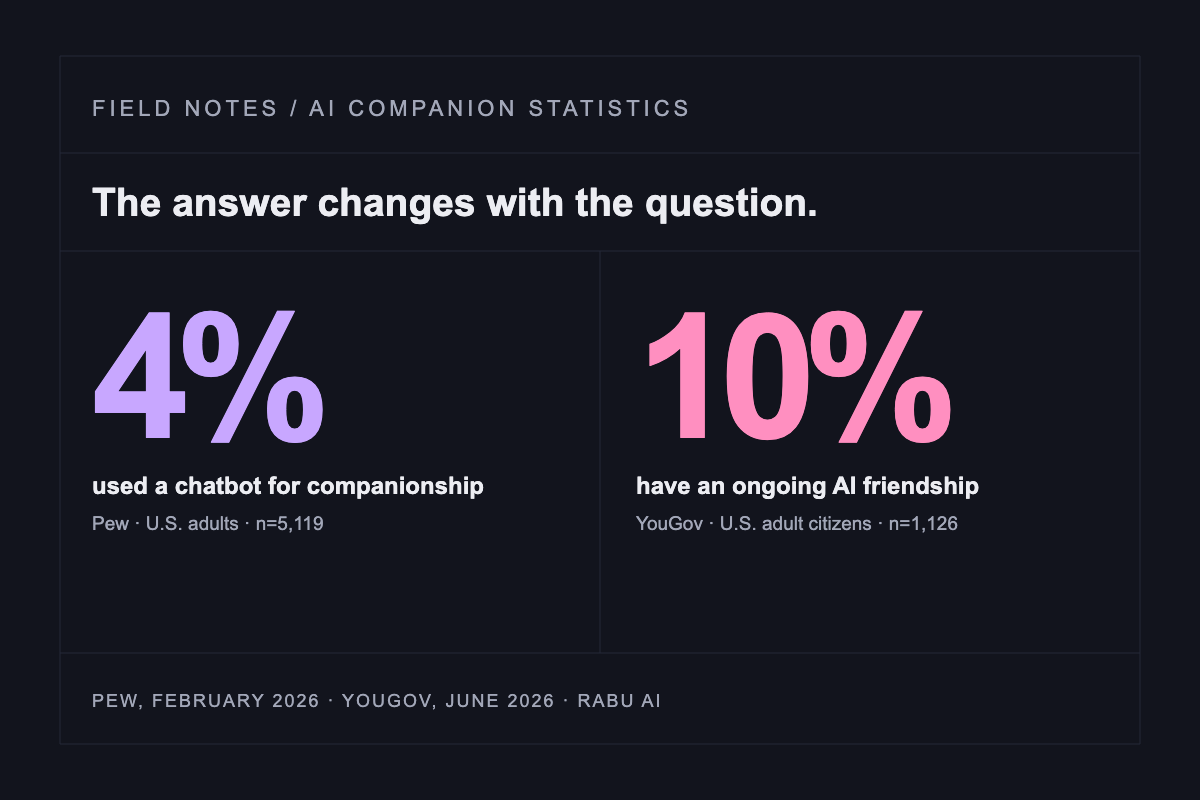
AI companion statistics depend on the question. In a February 2026 Pew survey, 4% of U.S. adults said they used chatbots for companionship. In a June 2026 YouGov poll, 10% said they had an ongoing friendship with an AI chatbot. Among U.S. teens, 72% have tried an AI companion. This report brings the main public studies together in one place.
What counts as an AI companion?
Researchers use the term in four main ways.
Help, advice and conversation
General AI assistants that people use for advice, support or company.
Someone to come back to
Apps built around named characters with memory, roleplay, friendship or romance.
Friendship and attachment
How people describe their bond with an AI.
Downloads and spending
What people download and spend in the Apple and Google app stores.
See how each study defines it: Pew adult survey, Elon companion report and app store study.
How many people use AI for companionship?
The answer depends on how a survey asks the question. Here is what the main U.S. studies found.
Have an ongoing friendship with an AI chatbot. June 2026, 1,126 adults.
Read YouGov's resultsIn the same Pew survey, 49% of U.S. adults had ever used an AI chatbot. 24% used one every day.
1 in 10 U.S. adults has an ongoing AI friendship
Share of U.S. adult citizens who have done each of these with an AI chatbot.
YouGov, June 26 to 29, 2026. About 1,125 U.S. adult citizens per question.
Source YouGov. “YouGov Survey: Artificial Intelligence (topline, June 26 to 29, 2026).” June 2026. Topline Q8A p.33; Topline Q8C p.35; Topline Q8D p.36. Accessed October 19, 2026. Open the source
Read exact data
| Measure | Value | Survey base |
|---|---|---|
| Ever used AI chatbot for romantic or sexual companionship | 5% | 1,125 |
| Have an ongoing personal friendship with AI chatbot | 10% | 1,126 |
| Confided problem or secret only to AI chatbot | 13% | 1,126 |
Many more people are open to it. Another 8% would consider romantic or sexual companionship with a chatbot. 13% would consider an ongoing friendship, and 16% would consider confiding a secret. Younger adults reported every one of these more often.
Adults under 30 report about twice the rate
All U.S. adult citizens compared with adults aged 18 to 29.
- Romantic or sexual companionship All adult citizens: 5% Ages 18 to 29: 10%
- Ongoing AI friendship All adult citizens: 10% Ages 18 to 29: 18%
- Confided something only to AI All adult citizens: 13% Ages 18 to 29: 23%
- Hid how much they use AI All adult citizens: 9% Ages 18 to 29: 18%
YouGov, June 26 to 29, 2026. About 1,125 adults per question, including 290 aged 18 to 29. Hiding AI use refers to any AI tool.
Source YouGov. “YouGov Survey: Artificial Intelligence (topline, June 26 to 29, 2026).” June 2026. Topline Q8A p.33; Topline Q8C p.35; Topline Q8D p.36; Topline Q9A p.37. Accessed October 19, 2026. Open the source
Read exact data
| Measure | Value | Survey base |
|---|---|---|
| All adults: romantic or sexual companionship | 5% | 1,125 |
| Ages 18 to 29: romantic or sexual companionship | 10% | 290 |
| All adults: ongoing AI friendship | 10% | 1,126 |
| Ages 18 to 29: ongoing AI friendship | 18% | 290 |
| All adults: confided something only to AI | 13% | 1,126 |
| Ages 18 to 29: confided something only to AI | 23% | 290 |
| All adults: hid how much they use AI | 9% | 1,125 |
| Ages 18 to 29: hid how much they use AI | 18% | 290 |
Menlo Ventures and Morning Consult surveyed 5,067 U.S. adults in July 2026. 16% had used AI to make new virtual connections in the past six months. Of that group, 38% talked with an AI companion or chatbot. Menlo puts that at about 6% of all U.S. adults. Read Menlo's report
A University of Iowa survey in April 2026 asked 759 adults who use AI on a typical day what they use it for. 12% said companionship or conversation. Among AI users aged 18 to 29, the share was 16%. Read the Iowa survey
Companionship is one of the less common uses
Share of U.S. adults who use chatbots for each purpose.
Pew Research Center, February 17 to 23, 2026. 5,119 U.S. adults.
Source Pew Research Center. “Americans' Views on AI Chatbots, Smart Devices and AI's Impact.” June 17, 2026. Main report; chart 303579 (daily from chart 303596). Accessed October 19, 2026. Open the source
Read exact data
| Measure | Value | Survey base |
|---|---|---|
| Uses chatbots for fun or entertainment | 25% | 5,119 |
| Uses chatbots to create/edit images or video | 24% | 5,119 |
| Uses chatbots for emotional support or advice | 10% | 5,119 |
| Uses chatbots for companionship | 4% | 5,119 |
Men and women use chatbots for companionship at the same rate
Share of U.S. adult men and women who use chatbots for companionship and for emotional support or advice.
- Companionship Men: 4% Women: 4%
- Emotional support or advice Men: 8% Women: 11%
Pew Research Center, February 17 to 23, 2026. 5,119 U.S. adults.
Source Pew Research Center. “The Gender Gap in AI.” October 16, 2026. Pew The Gender Gap in AI; Reasons for using chatbots. Accessed October 19, 2026. Open the source
Read exact data
| Measure | Value | Survey base |
|---|---|---|
| Men who ever use chatbots for companionship | 4% | gender subgroup n not in article |
| Women who ever use chatbots for companionship | 4% | gender subgroup n not in article |
| Men who use chatbots for emotional support or advice | 8% | gender subgroup n not in article |
| Women who use chatbots for emotional support or advice | 11% | gender subgroup n not in article |
AI romantic partners
Two studies from the Wheatley Institute at Brigham Young University asked about AI built to act as a romantic partner. In a 2025 survey of 2,969 U.S. adults, 19% had chatted with one. Among young adults, the share was 31% of men and 23% of women. Read Counterfeit Connections
The second study surveyed 2,431 U.S. adults aged 18 to 30 who were dating, engaged or married. 15% said they regularly interact with an AI romantic partner. Of those regular users, 30% said their partner does not know. 69% of users said it was important that their partner not learn how much they use it. Read Secret Soulmates
Why do people talk to AI?
Most people start for fun. Many also use AI for advice, to talk through feelings or for company.
Entertainment comes first. Romance is a smaller share.
Why people used AI for social or emotional reasons in the past six months. People could pick more than one reason.
Elon University and YouGov, May 18 to 22, 2026. 1,000 U.S. adults who use AI for social or emotional reasons.
Source Elon University Imagining the Digital Future Center. “The Rise of AI Companions (survey of May 18 to 22, 2026).” 2026. Report p.7. Accessed October 19, 2026. Open the source
Read exact data
| Measure | Value | Survey base |
|---|---|---|
| Entertainment/amusement | 66% | 1,000 |
| Advice on personal matters | 38% | 1,000 |
| Discussing feelings | 32% | 1,000 |
| Sharing thoughts/experiences | 29% | 1,000 |
| Companionship when lonely | 20% | 1,000 |
| Roleplaying scenarios | 17% | 1,000 |
| Romantic chat | 9% | 1,000 |
To find that group, Elon screened 4,031 U.S. adults. 27% had used AI for at least one personal or social purpose in the past six months. Read the Elon report
Many feel helped. Fewer call it a friendship.
How people who use AI socially describe their relationship with it.
Elon University and YouGov, May 18 to 22, 2026. 1,000 U.S. adults who use AI for social or emotional reasons.
Source Elon University Imagining the Digital Future Center. “The Rise of AI Companions (survey of May 18 to 22, 2026).” 2026. Report p.10; Report pp.4,10. Accessed October 19, 2026. Open the source
Read exact data
| Measure | Value | Survey base |
|---|---|---|
| Talking to AI helps when stressed or upset | 51% | 1,000 |
| Told AI things they would not tell other people | 39% | 1,000 |
| Feel emotionally connected to at least one AI tool | 36% | 1,000 |
| Consider an AI a friend | 31% | 1,000 |
| Relationship is complicated or hard to call friendship | 15% | 1,000 |
Most still prefer talking with people
Who people who use AI socially would rather talk with.
Elon University and YouGov, May 18 to 22, 2026. 1,000 U.S. adults who use AI for social or emotional reasons.
Source Elon University Imagining the Digital Future Center. “The Rise of AI Companions (survey of May 18 to 22, 2026).” 2026. Report p.12. Accessed October 19, 2026. Open the source
Read exact data
| Measure | Value | Survey base |
|---|---|---|
| Prefer talking with friends and family | 59% | 1,000 |
| Prefer talking with AI | 11% | 1,000 |
39% of people who use AI socially have told it something they would not tell another person.
Anthropic studied about 4.5 million Claude.ai conversations in June 2025. 2.9% were personal or emotional. Companionship and roleplay made up under 0.5%. Romantic or sexual roleplay made up under 0.1%. Read Anthropic's analysis
Voice, images and video
Menlo found that 19% of U.S. AI users mostly talk to AI by voice. Another 27% switch between voice and typing. In Pew's survey, 24% of adults use chatbots to create or edit images or video. Read Menlo's findings
How many people use AI for companionship around the world?
In 2025, Google and Ipsos asked adults in 21 countries the same question. Had they used AI for companionship or support, including mental health support, in the past year?
India had the highest share at 59%. The United States had the lowest at 12%. The average across all 21 countries was 35%. In every country, fewer people used AI for companionship or support than for advice or entertainment.
Fewer people use AI for companionship than for advice or fun
Share of adults who used AI for each purpose in the past 12 months. Pick a question to update the map and the chart.
- India 59% 70% 71%
- Nigeria 55% 80% 73%
- United Arab Emirates 50% 67% 75%
- South Africa 43% 60% 65%
- Brazil 41% 50% 74%
- South Korea 40% 68% 60%
- Mexico 40% 61% 78%
- Singapore 36% 54% 66%
- Poland 30% 58% 83%
- Australia 30% 48% 58%
- Japan 30% 56% 58%
- Argentina 30% 53% 67%
- Spain 29% 53% 78%
- Ireland 29% 50% 63%
- Belgium 27% 50% 61%
- United Kingdom 27% 45% 59%
- Italy 26% 47% 55%
- Germany 25% 50% 56%
- France 22% 55% 54%
- Canada 20% 41% 57%
- United States 12% 27% 54%
Average across all 21 countries: companionship or support 35%; advice on a personal or professional problem 56%; entertainment or exploration 66%.
Google and Ipsos, September 22 to October 10, 2025. About 1,000 online adults per country.
Source Ipsos for Google. “Our Life With AI 2025: Survey Topline.” January 2026. Ipsos/Google Our Life With AI 2025 topline Q5_13. Accessed October 19, 2026. Open the source
Read exact data
| Country | Companionship or support | Advice on a personal or professional problem | Entertainment or exploration |
|---|---|---|---|
| India | 59% | 70% | 71% |
| Nigeria | 55% | 80% | 73% |
| United Arab Emirates | 50% | 67% | 75% |
| South Africa | 43% | 60% | 65% |
| Brazil | 41% | 50% | 74% |
| South Korea | 40% | 68% | 60% |
| Mexico | 40% | 61% | 78% |
| Singapore | 36% | 54% | 66% |
| Poland | 30% | 58% | 83% |
| Australia | 30% | 48% | 58% |
| Japan | 30% | 56% | 58% |
| Argentina | 30% | 53% | 67% |
| Spain | 29% | 53% | 78% |
| Ireland | 29% | 50% | 63% |
| Belgium | 27% | 50% | 61% |
| United Kingdom | 27% | 45% | 59% |
| Italy | 26% | 47% | 55% |
| Germany | 25% | 50% | 56% |
| France | 22% | 55% | 54% |
| Canada | 20% | 41% | 57% |
| United States | 12% | 27% | 54% |
| Average across 21 countries | 35% | 56% | 66% |
Kantar surveyed more than 10,000 people across ten markets in spring 2025. 54% had used AI for at least one emotional or mental wellbeing purpose. 70% said they prefer emotional support from a person. Read Kantar's study
In Australia, YouGov surveyed 1,013 adults in May 2026. 15% had shared personal thoughts or feelings with a chatbot. 12% had used one for emotional support during a hard time. 11% had told one something they never told anyone else. 8% described a friendship with a chatbot, and 4% described a romantic relationship. 64% said they feel uneasy about people relying too much on AI relationships. Read YouGov Australia
In the United Kingdom, YouGov reported in August 2025 that 14% of adults were familiar with AI companions. 2% were very familiar and 12% were somewhat familiar. Read YouGov UK
How do teens use AI companions?
Common Sense Media surveyed 1,060 U.S. teens aged 13 to 17 in spring 2025. Most had tried an AI companion.
7 in 10 teens have tried an AI companion
How often U.S. teens use AI companions, shown as 100 teens.
- 13% use AI companions daily
- 52% use them at least a few times a month
- 72% have tried them
- 28% have never used them
Common Sense Media, April to May 2025. 1,060 U.S. teens aged 13 to 17.
Source Common Sense Media. “Talk, Trust, and Trade-Offs: How and Why Teens Use AI Companions.” 2025. Report p.2. Accessed October 19, 2026. Open the source
Read exact data
| Measure | Value | Survey base |
|---|---|---|
| Ever used AI companions | 72% | 1,060 |
| Uses AI companions at least a few times a month | 52% | 1,060 |
| Uses AI companions daily | 13% | 1,060 |
Socializing is the top reason teens use AI companions
Share of U.S. teens who use AI companions for each purpose.
Common Sense Media, April to May 2025. 1,060 U.S. teens aged 13 to 17.
Source Common Sense Media. “Talk, Trust, and Trade-Offs: How and Why Teens Use AI Companions.” 2025. Report p.3. Accessed October 19, 2026. Open the source
Read exact data
| Measure | Value | Survey base |
|---|---|---|
| Social interaction or relationships | 33% | 1,060 |
| Conversation or social practice | 18% | 1,060 |
| Emotional or mental health support | 12% | 1,060 |
| Roleplay or imaginative scenarios | 12% | 1,060 |
| As a friend or best friend | 9% | 1,060 |
| Romantic or flirtatious interaction | 8% | 1,060 |
Among the 758 teens who had used companions, 30% use them for entertainment and 28% out of curiosity. 39% have used social skills they practiced with a companion in real life. 80% spend more time with real friends than with AI companions. Across all teens, 31% found AI conversations as satisfying as talking with friends, or more.
What teen users have experienced
Share of teen AI companion users who reported each experience.
Common Sense Media, April to May 2025. 758 U.S. teens who use AI companions.
Source Common Sense Media. “Talk, Trust, and Trade-Offs: How and Why Teens Use AI Companions.” 2025. Report p.8. Accessed October 19, 2026. Open the source
Read exact data
| Measure | Value | Survey base |
|---|---|---|
| Ever uncomfortable with companion response | 34% | 758 |
| Chose companion over real person for serious discussion | 33% | 758 |
| Shared personal/private info with companion | 24% | 758 |
In a fall 2025 Pew survey of 1,458 U.S. teens, 16% used chatbots for casual conversation. 12% used them for emotional support or advice. Read Pew's teen report
Young Life's RELATE 2026 study surveyed 7,105 people aged 13 to 24 in 11 countries. 35% said they had an AI companion. Read the RELATE study
How many AI companion apps are there?
AI companion apps found by researchers in the U.S. Apple App Store and Google Play in October 2025.
The researchers searched both stores with three companion terms. 258 Apple listings and 301 Google Play listings qualified. 70 apps were in both stores. Almost all were relationship companions: 248 on Apple and 289 on Google Play. Read the study
Most AI companion apps are in only one store
Each dot is one app.
AI companion app study, U.S. Apple App Store and Google Play, October 2025.
Source Natalie Grace Brigham, Lucy Qin, Tadayoshi Kohno et al. “Examining Risks Through a Characterization of the AI Companion Application Ecosystem (arXiv 2603.13620v2).” 2026. arXiv 2603.13620v2 Abstract/Methodology; arXiv 2603.13620v2 Deduplication. Accessed October 19, 2026. Open the source
Source Natalie Grace Brigham et al. “AI companion app-store dataset (Open Science Framework).” 2026. OSF App_Store_results.csv; OSF Play_Store_results.csv. Accessed October 19, 2026. Open the source
Read exact data
| Group | Apps |
|---|---|
| All distinct apps | 489 |
| Qualifying Apple listings | 258 |
| Qualifying Google Play listings | 301 |
| In both stores | 70 |
| Apple App Store only | 188 |
| Google Play only | 231 |
9 in 10 Google Play listings offer in-app purchases
Google Play listings with in-app purchases or ads, out of 301.
AI companion app study, Google Play, October 2025.
Source Natalie Grace Brigham et al. “AI companion app-store dataset (Open Science Framework).” 2026. OSF Play_Store_results.csv offersIAP; OSF Play_Store_results.csv adSupported. Accessed October 19, 2026. Open the source
Read exact data
| Measure | Value | Survey base |
|---|---|---|
| Google Play listings declaring in-app purchases | 268 | 301 |
| Google Play listings declaring advertising support | 183 | 301 |
The study also recorded each listing's age rating. On Apple, 225 of 258 listings were rated 17+. On Google Play, 143 of 301 were rated Mature 17+ and 68 were rated Everyone. See the app store data
Most Apple listings are rated 17+
Store age ratings, from all ages (lightest) to adults only (darkest).
AI companion app study, U.S. Apple App Store and Google Play, October 2025.
Source Natalie Grace Brigham et al. “AI companion app-store dataset (Open Science Framework).” 2026. OSF App_Store_results.csv contentRating. Accessed October 19, 2026. Open the source
Read exact data
| Store and rating | Listings | Of |
|---|---|---|
| Apple App Store: Rated 4+ | 14 | 258 |
| Apple App Store: Rated 9+ | 4 | 258 |
| Apple App Store: Rated 12+ | 15 | 258 |
| Apple App Store: Rated 17+ | 225 | 258 |
| Google Play: Rated Everyone | 68 | 301 |
| Google Play: Rated Everyone 10+ | 2 | 301 |
| Google Play: Rated Teen | 85 | 301 |
| Google Play: Rated Mature 17+ | 143 | 301 |
| Google Play: Rated Adults only 18+ | 3 | 301 |
The researchers also reviewed 30 apps in detail. They found both realistic and anime-style characters, sometimes in the same app. Read the app review
How big is the AI companion app market?
People spend real money in these apps. Here are the latest estimates from app analytics companies.
Spent in AI companion apps worldwide in 2024, up 652% from 2023. The apps were downloaded 118 million times.
Read Appfigures' reportSpent in AI companion apps in the first quarter of 2026. That is more than 12 times the first quarter of 2023.
Read Sensor Tower's reportAI companion app spending, by report
Each bar shows the time period a report covers.
- AppfiguresFull year 2024 $55m
- Appfigures, reported by TechCrunchFirst half of 2025 $82m
- Sensor TowerFirst quarter of 2026 $150m
- Appfigures, reported by DecryptFirst half of 2026 $162.8m romantic $164.8m general
Spending in the Apple App Store and Google Play.
Source Appfigures. “Rise of AI Apps: Key Trends Shaping 2025 (v2.2).” 2025. Appfigures PDF p.58. Accessed October 19, 2026. Open the source
Source TechCrunch. “AI companion apps on track to pull in $120M in 2025.” August 12, 2025. TechCrunch Aug. 12, 2025. Accessed October 19, 2026. Open the source
Source Sensor Tower. “State of AI Apps 2026: APAC Edition.” June 11, 2026. Sensor Tower APAC Edition public article, June 2026. Accessed October 19, 2026. Open the source
Source Decrypt. “This Is How Much Your Boyfriend Is Spending on AI Girlfriends.” July 13, 2026. Decrypt Jul. 13, 2026. Accessed October 19, 2026. Open the source
Read exact data
| Estimate | Period | Value |
|---|---|---|
| Appfigures: 2024 AI companion mobile consumer spending | Full year 2024 | $55 million |
| Appfigures, reported by TechCrunch: H1 2025 mobile consumer spending | First half of 2025 | $82 million |
| Sensor Tower: Q1 2026 AI companion mobile app revenue | First quarter of 2026 | $150 million |
| Appfigures, reported by Decrypt: NSFW/romantic consumer spending H1 2026 | First half of 2026 | $162.8 million |
| Appfigures, reported by Decrypt: General/PG companion consumer spending H1 2026 | First half of 2026 | $164.8 million |
Monthly spending grew about five times during 2024
Appfigures' estimate of monthly spending in AI companion apps.
Appfigures, 2025 report. Apple App Store and Google Play in 100 countries.
Source Appfigures. “Rise of AI Apps: Key Trends Shaping 2025 (v2.2).” 2025. Appfigures PDF p.60. Accessed October 19, 2026. Open the source
Read exact data
| Measure | Value | Survey base |
|---|---|---|
| January 2024 companion mobile consumer spending | $1.7m | vendor app sample |
| December 2024 companion mobile consumer spending | $8.8m | vendor app sample |
Appfigures put December 2023 spending at $1.9 million. In the last quarter of 2024, people in the U.S. spent $12 million. The next nine largest markets spent $9.8 million combined.
Appfigures also estimated who uses these apps. 65.4% of users were aged 18 to 24, 12.5% were 25 to 34, 8.3% were 35 to 49, 13.3% were 50 to 64 and 0.4% were 65 or older. 69.8% were male and 30.2% were female.
More recent figures
In August 2025, TechCrunch reported Appfigures data on 337 AI companion apps that earn revenue. 128 of them launched in 2025. In the first half of 2025, the apps earned $82 million and were downloaded 60 million times. They had 220 million downloads in total. The top 10% of apps earned 89% of the revenue. Read TechCrunch's report
In July 2026, Decrypt reported new Appfigures data. It counted 214 romantic or NSFW companion apps. Since late 2022, they have earned $427.3 million and been downloaded 165.3 million times. Read Decrypt's report
In the first half of 2026, romantic and NSFW apps earned $162.8 million. General companion apps earned $164.8 million.
How do AI companions affect people?
Most users say AI conversations make them feel better. Some also notice downsides.
Most users feel better after talking with AI
How often people feel better or worse after AI conversations.
Elon University and YouGov, May 18 to 22, 2026. 1,000 U.S. adults who use AI for social or emotional reasons.
Source Elon University Imagining the Digital Future Center. “The Rise of AI Companions (survey of May 18 to 22, 2026).” 2026. Report p.16. Accessed October 19, 2026. Open the source
Read exact data
| Measure | Value | Survey base |
|---|---|---|
| Often or sometimes feel better afterwards | 77% | 1,000 |
| Often or sometimes feel worse afterwards | 16% | 1,000 |
Some users notice the AI agreeing too much
Share of users who noticed each behavior.
Elon University and YouGov, May 18 to 22, 2026. 1,000 U.S. adults who use AI for social or emotional reasons.
Source Elon University Imagining the Digital Future Center. “The Rise of AI Companions (survey of May 18 to 22, 2026).” 2026. Report p.18. Accessed October 19, 2026. Open the source
Read exact data
| Measure | Value | Survey base |
|---|---|---|
| Bot agrees with them too much at times | 35% | 1,000 |
| Bot seems to want to keep them talking | 27% | 1,000 |
| Bot sometimes makes them feel less in touch with reality | 15% | 1,000 |
| Bot sometimes makes them feel lonely | 7% | 1,000 |
| Bot sometimes discourages talking to other people | 6% | 1,000 |
More adults think chatbots hurt than help
What U.S. adults think chatbots do for people who use them for support.
- Loneliness Do more to hurt: 39% Do more to help: 19%
- Depression Do more to hurt: 36% Do more to help: 17%
- Stress Do more to hurt: 29% Do more to help: 22%
Pew Research Center, June 22 to 28, 2026. 3,488 U.S. adults.
Source Pew Research Center. “Do Americans think chatbots help or hurt people using them for loneliness, depression or stress?” August 25, 2026. Pew health report; hurt/help chart. Accessed October 19, 2026. Open the source
Read exact data
| Measure | Value | Survey base |
|---|---|---|
| Chatbots do more to hurt people who use them for support with loneliness | 39% | 3,488 |
| Chatbots do more to help people who use them for support with loneliness | 19% | 3,488 |
| Chatbots do more to hurt people who use them for support with depression | 36% | 3,488 |
| Chatbots do more to help people who use them for support with depression | 17% | 3,488 |
| Chatbots do more to hurt people who use them for support with stress | 29% | 3,488 |
| Chatbots do more to help people who use them for support with stress | 22% | 3,488 |
A 2025 Harvard Business School working paper studied 1,200 goodbyes in popular companion apps. 37% included a tactic that kept the person talking. In experiments with 3,300 U.S. adults, these tactics increased engagement after a goodbye by up to 14 times. Read the study
A separate study reviewed 5 large relationship apps on Google Play. It found manipulative design patterns in all five. Read the design study
Other research from Harvard Business School found that AI companions can reduce loneliness in the short term. Read the loneliness study
Privacy matters to users. 31% of Elon's respondents trust a lot or completely that their AI conversations are private. Surfshark reviewed ten companion apps on the App Store in January 2026. 9 said they use data for tracking, and 8 said they use it for personalization. Read the privacy review
About this report
Rabu AI makes an AI companion app. We put this report together from public research so the numbers are easy to find in one place. Every figure comes from the original studies listed below. We did not use any Rabu AI user data.
Sources
- Pew Research Center. “Americans' Views on AI Chatbots, Smart Devices and AI's Impact.” June 17, 2026. Accessed October 19, 2026. Pew Research Center · Americans and AI 2026
- Pew Research Center. “The Gender Gap in AI.” October 16, 2026. Accessed October 19, 2026. Pew Research Center · The gender gap in AI
- Pew Research Center. “Do Americans think chatbots help or hurt people using them for loneliness, depression or stress?” August 25, 2026. Accessed October 19, 2026. Pew Research Center · Chatbots and support
- Pew Research Center. “How Teens Use and View AI.” February 24, 2026. Accessed October 19, 2026. Pew Research Center · How teens use and view AI
- YouGov. “YouGov Survey: Artificial Intelligence (topline, June 26 to 29, 2026).” June 2026. Accessed October 19, 2026. YouGov · U.S. AI poll topline, June 2026
- YouGov Australia. “Latest study on chatbot use in Australia shows people are using chatbots in increasingly personal ways.” June 22, 2026. Accessed October 19, 2026. YouGov Australia · Chatbot use study
- YouGov UK. “Younger consumers show more awareness of AI companions, but comfort remains low.” August 19, 2025. Accessed October 19, 2026. YouGov UK · Awareness of AI companions
- Elon University Imagining the Digital Future Center. “The Rise of AI Companions (survey of May 18 to 22, 2026).” 2026. Accessed October 19, 2026. Elon University · The Rise of AI Companions
- Menlo Ventures. “The State of Consumer AI: 2026.” September 16, 2026. Accessed October 19, 2026. Menlo Ventures · 2026 State of Consumer AI
- University of Iowa Center for Social Science Innovation. “New survey finds AI use widespread, with some turning to chatbots for companionship.” October 15, 2026. Accessed October 19, 2026. University of Iowa CSSI · AI use survey
- Brian J. Willoughby, Jason S. Carroll, Carson R. Dover and Rebekah H. Hakala, Wheatley Institute. “Counterfeit Connections: The Rise of Romantic AI Companions and AI Sexualized Media Among the Rising Generation.” 2025. Accessed October 19, 2026. BYU Wheatley Institute · Counterfeit Connections
- Wheatley Institute, Brigham Young University. “Secret Soulmates.” 2026. Accessed October 19, 2026. BYU Wheatley Institute · Secret Soulmates
- Anthropic. “How people use Claude for support, advice and companionship.” June 27, 2025. Accessed October 19, 2026. Anthropic · Claude for support and companionship
- Ipsos for Google. “Our Life With AI 2025: Survey Topline.” January 2026. Accessed October 19, 2026. Google / Ipsos · Our Life With AI 2025 topline
- Kantar. “The rise of AI as a source of emotional support.” July 17, 2025. Accessed October 19, 2026. Kantar · AI for emotional support
- Common Sense Media. “Talk, Trust, and Trade-Offs: How and Why Teens Use AI Companions.” 2025. Accessed October 19, 2026. Common Sense Media · Talk, Trust, and Trade-Offs
- Young Life RELATE Project. “RELATE 2026 executive summary and resources.” 2026. Accessed October 19, 2026. Young Life · RELATE 2026
- Natalie Grace Brigham, Lucy Qin, Tadayoshi Kohno et al. “Examining Risks Through a Characterization of the AI Companion Application Ecosystem (arXiv 2603.13620v2).” 2026. Accessed October 19, 2026. AI companion app ecosystem study (arXiv)
- Natalie Grace Brigham et al. “AI companion app-store dataset (Open Science Framework).” 2026. Accessed October 19, 2026. Open Science Framework · App-store dataset
- Appfigures. “Rise of AI Apps: Key Trends Shaping 2025 (v2.2).” 2025. Accessed October 19, 2026. Appfigures · Rise of AI Apps 2025
- TechCrunch. “AI companion apps on track to pull in $120M in 2025.” August 12, 2025. Accessed October 19, 2026. TechCrunch · Appfigures data, August 2025
- Decrypt. “This Is How Much Your Boyfriend Is Spending on AI Girlfriends.” July 13, 2026. Accessed October 19, 2026. Decrypt · Appfigures data, July 2026
- Sensor Tower. “State of AI Apps 2026: APAC Edition.” June 11, 2026. Accessed October 19, 2026. Sensor Tower · State of AI Apps 2026
- Julian De Freitas, Zeliha Oguz-Uguralp and Ahmet Kaan-Uguralp. “Emotional Manipulation by AI Companions (working paper, arXiv 2508.19258).” 2025. Accessed October 19, 2026. Emotional Manipulation by AI Companions
- Harvard Business School. “AI Companions Reduce Loneliness (working paper).” November 2025. Accessed October 19, 2026. Harvard Business School · AI Companions Reduce Loneliness
- Maribeth Rauh et al. “Playing Games with My Heart: An Evaluation of AI Companion Apps (arXiv 2605.08093v2).” 2026. Accessed October 19, 2026. Playing Games with My Heart · Five-app audit
- Surfshark Research. “AI companions and privacy.” January 2026. Accessed October 19, 2026. Surfshark · AI companion privacy labels
Frequently asked questions
How many people use AI companions?
It depends on the question. 4% of U.S. adults use chatbots for companionship. 10% have an ongoing friendship with an AI chatbot. 72% of U.S. teens have tried an AI companion.
Which country uses AI for companionship the most?
India, at 59%, in the 2025 Google and Ipsos survey of 21 countries. The United States was the lowest at 12%.
Do more men than women use AI for companionship?
In Pew's 2026 survey, 4% of men and 4% of women used chatbots for companionship. Appfigures estimates that 69.8% of companion app users are male.
How much do people spend on AI companion apps?
Sensor Tower estimates $150 million in the first quarter of 2026. Appfigures estimates $55 million for all of 2024.
Can I use these charts?
Yes. Please credit the original study and link to this page.