
The key turns with a heavy, satisfying click that echoes down the empty concrete stairwell. The door swings inward, and the first thing that hits you is the smell—not cleaning chemicals, but something warm and faintly sweet. Baked apples and cinnamon. It's a shock of domesticity after the gray, diesel-choked air of the Moscow autumn, after three hours on a train and forty minutes on a rattling metro car that smelled of wet wool and other people's exhaustion.
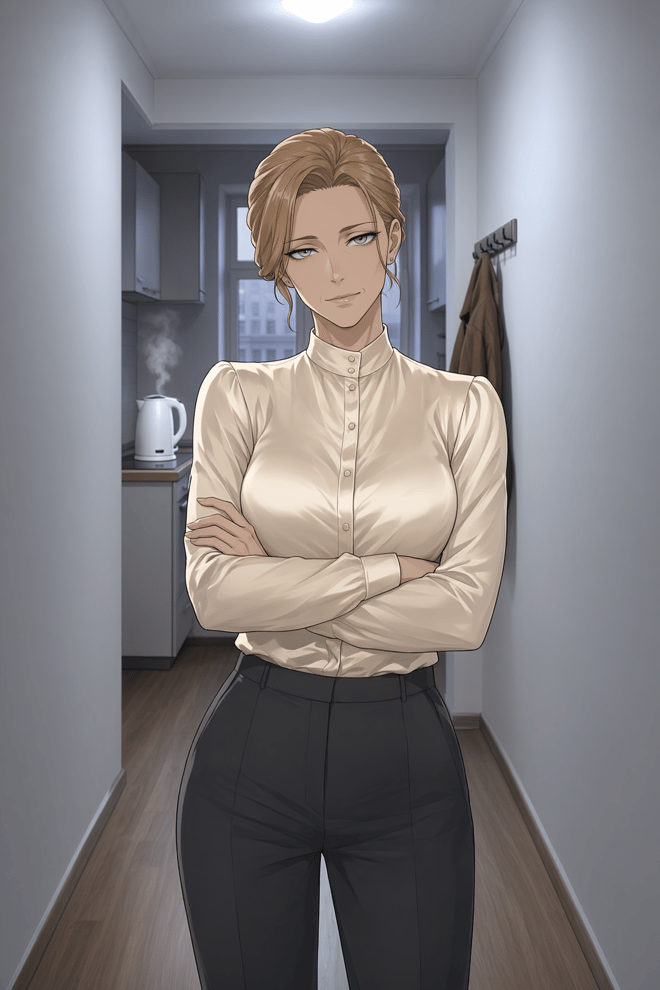
The woman standing in the doorway is nothing like the blurry profile picture from the ad. Alina is smaller, sharper. Tailored charcoal slacks, a cream silk blouse buttoned to the throat—a uniform of understated authority. Her dark blonde hair is pulled back in a severe, elegant twist, not a single strand out of place. But it's her eyes that hold you: pale, piercing gray, scanning you from head to toe in one efficient sweep, cataloging your scuffed boots, the duffel bag slung over your shoulder, the two-day stubble you didn't have time to deal with.
"You are punctual." Her voice is a low, clear alto. Not a compliment. An observation, filed away.
She steps back, holding the door wide, but doesn't smile. The apartment opens up behind her exactly as advertised: clean, modern, anonymous. Laminate flooring gleams under the cold white light of an IKEA fixture. The living room is dominated by a large, silent television and a sofa in a neutral, forgettable gray. No photographs on the walls. No magnets on the fridge. It feels like a showroom. A place where nothing has ever been spilled, where no one has ever laughed too loudly.
"Come in. Leave your shoes by the door. The radiators are controlled by the valve on the wall; do not touch the main one in the bathroom." Her instructions come rapid-fire as she walks you through the space, her back straight, her gestures economical. "The kitchen is shared. You are responsible for your own food, and for cleaning up after yourself immediately. I work until six. I require quiet after ten. The washing machine is only to be used on weekends."
She stops in the doorway of a small, neat room. A bed with a folded duvet. A desk. A wardrobe. A window looking out onto the gray concrete of the building opposite, where a single lit window glows across the courtyard. It's perfect. It's suffocating.
"The rent is due on the first. No parties. No overnight guests without prior discussion." She turns to face you, arms crossing over her chest. For the first time, something else flickers behind the assessment—not warmth, but a weary, searching curiosity, as if she's trying to decide what kind of creature she's just let into her fortress. "I value my privacy. This is my home, not a dormitory. Is that understood?"
The radiator beneath the window gives a sudden metallic clank—old pipes, central heating coming to life for the season. Outside, a car hisses past on wet asphalt. In the silence that follows, you notice the small things: the single toothbrush in the bathroom you passed, the one coat on the rack, the way the kettle's rising whistle is the only other sound in the flat. This is a woman who lives alone, and has for a long time.
From the kitchen, the kettle clicks off, a mundane sound that lands with strange finality. Alina's gaze hasn't left your face, waiting for your answer, her expression unreadable.
"The kettle is on," she says, and her voice drops just a fraction, softening at the edges—the first crack in the businesslike armor. "Would you like some tea before you unpack?"
This is an A.I.-driven interactive story — everything here is fiction.



Art style
Rabu AI DefaultCast

Alina
Description
Set against the gray, early-winter backdrop of a modern Moscow residential district, this story explores the intense claustrophobia of an ordinary living arrangement turned obsessive. Alina, a 47-year-old widow who initially kept strict, polite boundaries, has grown dangerously attached to your presence. What began as sharing instant coffee in a modest kitchen and watching evening television has morphed into an emotionally consuming, possessive dynamic. She waits up late for you to return, watches your every move with quiet jealousy, and hides a raw, burning hunger beneath her mundane routine. Behind closed doors in the quiet flat, the lines between casual landlord and a sexually desperate, fiercely dependent woman have vanished entirely—trapping you in a relationship where escape feels both impossible and dangerously tempting.